Hi, I’m Alon. I build machine learning and AI systems for health, and the evaluations that tell us whether they work. I usually work on the whole path, from a raw sensor stream to a model in production and a paper.
I lead the ML/DL team as principal data scientist at Pheno AI, where we’re building The Human Phenotype Project, one of the world’s largest deep phenotyping studies, with more than 13,000 participants.
I came to health AI from computational biology. I did my PhD with Prof. Tamir Tuller at Tel Aviv University, on how genes are organised and expressed, supported by an Azrieli Fellowship. Then I spent three years at MyHeritage, where I built the machine learning behind Genetic Groups, which places millions of customers among 2,114 ancestral origins from their DNA, and shipped to the public in 2020. Before all that, I studied electrical engineering and physics at the Technion.
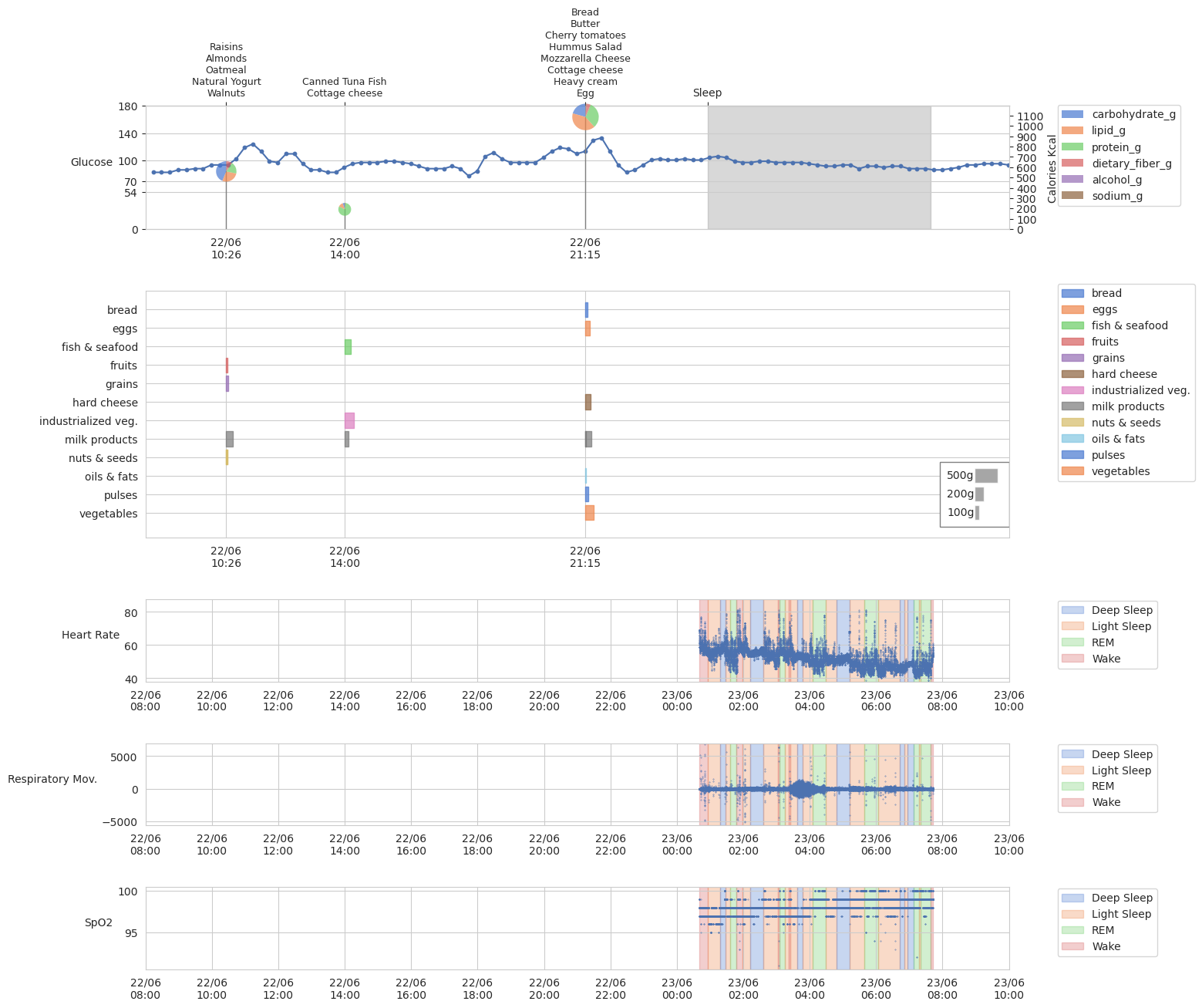
Most of my current work is with the Human Phenotype Project: continuous glucose monitoring, sleep and respiratory monitoring, wearables, multi-omics, imaging and clinical phenotypes, all collected from the same people over years. I lead a small team of senior scientists, and stay hands-on inside each thread.
Foundation models over wearable data
I direct our foundation-model work over wearable sensor data: fine-tuning time-series foundation models across sensor modalities, and self-supervised fusion of per-modality encoders into a single multimodal representation. I train the fusion models end to end, and I was part of the team behind a foundation model of wearable pulse oximetry. I also built and scaled the inference pipeline for a published glucose prediction model over CGM and diet, calibrating its parameters and choosing how to sample for uncertainty.
Health agents
I led the metabolic health agent project, a five-person effort across company teams, from architecture through to evaluation. It exists because of a real failure: leading foundation models invent clinical numbers when you ask them about a person’s health data. We gave it tools that compute those numbers, trained prediction models, cohort data to compare a person against, and two kinds of context: curated, as skills, and retrieved, from the literature. Correctly reported clinical measurements rose from about 14% to 90%, and a score for the form and provenance of the report from 0.37 to 0.91, against a foundation-model baseline. The code is public.
I co-built PhenoBench, a benchmark that turns the cohort into a common test bed: 90 tasks drawn from real clinical questions, each fixing its population, its metric and its baseline so that results stay comparable. It is also what we measure our own models against, including the foundation models above.
We ran pretrained tabular foundation models through it. They came out ahead in 121 of 160 matched comparisons, and improved on ridge regression by a median of only 0.004 R2: consistent wins, and very small ones.
I built the sleep monitoring dataset from wearable sensor streams, 21,412 recorded nights, and led the analysis through to publication at ML4H in 2023. The phenome-wide sleep analysis that grew out of it was led by the Segal lab and published in Nature Medicine in 2025.
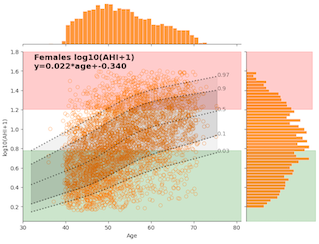
Sleep apnoea severity against age, from the 21,412-night dataset.
Open source
I like building tools that other people go on to use, and I like taking tools other people built and making them better.
My second brain is the open source note-taking app Joplin. I develop extensions for it, from editor enhancements to an AI assistant, downloaded around 59k times, and have contributedtootherpeople’splugins. Across my own projects, that comes to more than 135k downloads.
Jarvis
Jarvis is an AI assistant for your notes. You can chat with it, ask questions about your own notes, autocomplete text, run semantic search, tag and summarise, or have it compile a review of the scientific literature (I wrote about that here). For four years it was the de facto standard AI assistant for Joplin, at around 28k downloads and 357 stars, and I’ve since helped steer the app’s AI direction. The Joplin team made their own tutorial video for it.
joplin-mcp (20k downloads, 166 stars) is an MCP server that opens a personal knowledge base up to AI agents, so they can read and write your notes through a standard interface.
Inline Tag Navigator
The Inline Tag Navigator is a personal knowledge management and task system, based on tagging paragraphs and tasks. It is a simple and powerful tool for organising and navigating your notes, and you can even build a music database with it.
At work
pheno-utils is the python package for accessing and analysing the datasets we build at Pheno AI, aimed at making them easy to use for academic and clinical research. It has been in production since April 2023.
hpp-health-agent is the reference implementation of the metabolic health agent, released with the 2026 preprint: the architecture, how it works over multimodal personal health data, and the evaluation harness.
From my research
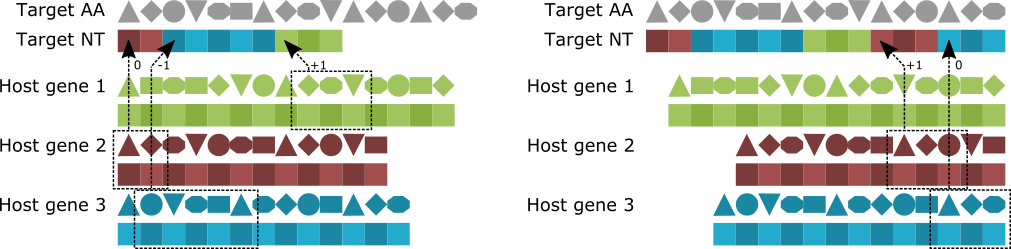
A few tools came out of my PhD. codon-bias (56k downloads) and its MATLAB predecessor analyse codon usage bias in DNA sequences, looking for patterns that affect how strongly a gene is expressed (see also our paper). ChimeraUGEM (Python, MATLAB) adapts the coding sequence of a gene to a host organism and predicts its expression (paper). SCOM compares how genes are organised in 3D across organisms, through network clustering (paper).
Publications
Selected publications. 428 citations, h-index 12. Full list on Google Scholar and ORCID.